

Sam Altman goes on late night TV as OpenAI panics
/
OpenAI code red as Gemini destroys ChatGPT
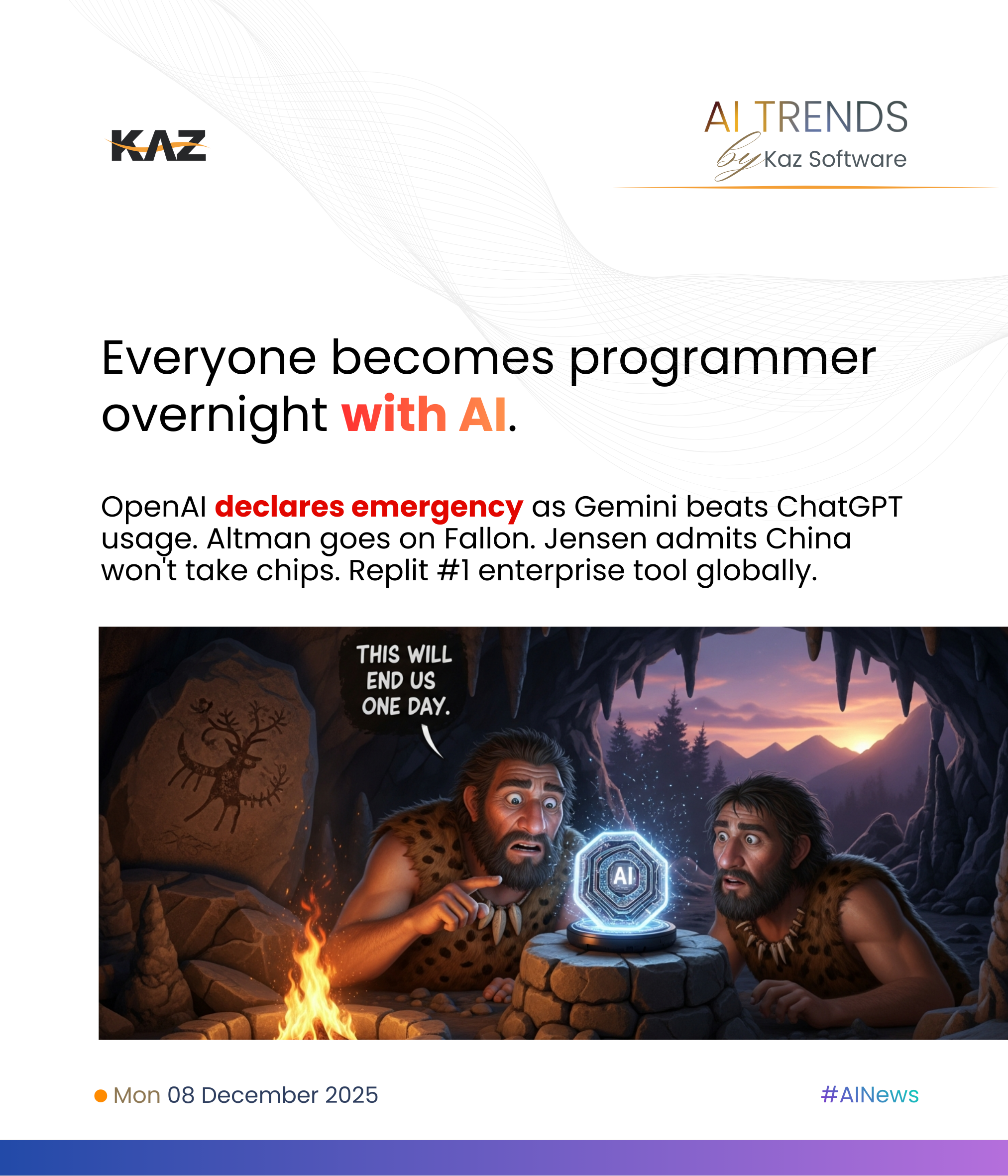
OpenAI declares "code red" as Gemini overtakes ChatGPT usage. Jensen begs Washington about China. Google-Replit deal signals enterprise vibe coding revolution.
Altman's Jimmy Fallon appearance reveals OpenAI's desperation to reset narrative
Sam Altman heading to Jimmy Fallon signals OpenAI is in crisis mode—you don't go on late night TV unless you need to reset the narrative with the public, especially when similar web data shows Gemini getting more engagement than ChatGPT and Altman himself reportedly told employees
"the vibes are rough these days."
This isn't about benchmarks or tech circles anymore; it's about ChatGPT being OpenAI's crown jewel and single point of failure, forcing them to put agents and ads on the back burner while appealing directly to the masses through comedy shows. Meanwhile, Jensen Huang shuttles between Washington and Beijing admitting he has "no idea whether China would even accept Nvidia's H20 chips if the US loosened restrictions" after being "the first company in history banned on both sides." Huang's desperate globe-trotting to fill the China demand gap with Middle East sovereign AI deals while Google's TPUs scale suggests Nvidia may get "squeezed on both sides" as their dominance faces unprecedented challenges. Are we witnessing the moment when AI's untouchable leaders finally feel vulnerable?

The OpenAI chief executive will make his Tonight Show Starring Jimmy Fallon debut on Monday, Dec. 8, a booking that arrives at a pivotal moment for both the company and the fast-moving generative-AI sector it helped ignite.
Google-Replit partnership reveals enterprise vibe coding's explosive growth
Replit CEO Amjad Masad called in from an Uber in Dubai to announce their multi-year Google Cloud partnership, revealing vibe coding has become "the number one growing enterprise tool in the world" according to Ramp data—not just in AI coding, but across all enterprise software categories. Consider the transformation Masad describes at enterprise scale:
Whoop fitness tracker: Previously shipped 2 ideas per quarter from 100, now product managers vibe code all 100 themselves. HR, sales, marketing teams all building internal tools integrating with BigQuery, Databricks, Snowflake
Development cycles cut by "orders of magnitude" as designers and PMs test directly with users. Google's Gemini 3 powers design capabilities while Flash 8 handles codebase search at near-zero cost
Matt Garner, Google Cloud president, confirms they're "the fastest growing hyperscaler for seven quarters" with AI driving the momentum, noting 60% of AI startups and all top 10 AI unicorns run on GCP. The partnership focuses on enterprise adoption through Google's marketplace and field organization, with Masad emphasizing "everyone in the organization is becoming a programmer—it's really a new world." Is traditional software development dead when non-technical teams can build production applications?
AI leaders reveal market inflated but real demand remains massive
When asked directly about AI bubbles, Google Cloud's president admits they're taking a "very methodic approach" spreading capacity across numerous customers with "balanced and approximate demand" rather than speculative far-future contracts, while Replit's CEO acknowledges "rapid copycats spending VC money on ads spinning wheels" but maintains real usage justifies the hype. Masad's perspective from the builder layer is telling: "You can vibe code a vibe coding tool very quickly but ultimately the depth of platform, safety, security primitives and deals like we're doing with Google are very important"—suggesting the market will separate real infrastructure from wrapper startups. Google's investment through their Future AI fund in Replit's last round, combined with Masad's claim they're "fairly capital efficient" and not raising despite VCs "knocking on our door," shows disciplined growth trumps hype-driven fundraising. As enterprises shift from individual coders to "full development organizations using vibe coding as material part of what they're bringing," will the next phase of AI be about boring enterprise adoption rather than flashy consumer demos?


