

AI bubble needs every iPhone user paying $35/month to break even
/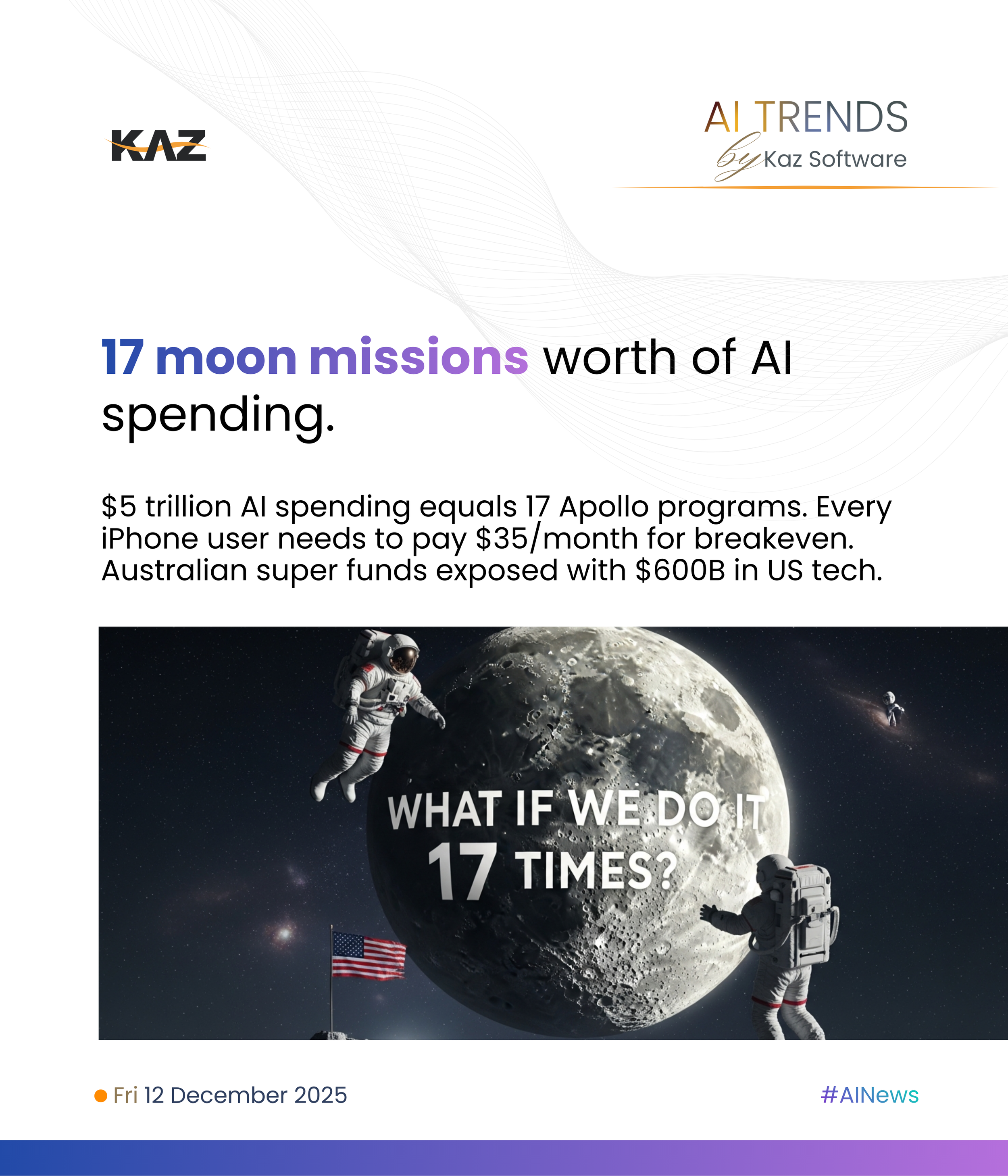
$5 trillion being spent on AI infrastructure equals 17 Apollo moon programs. Australian super funds trapped with $600B exposure to US tech stocks.
$5 trillion floods AI infrastructure—17 Apollo programs worth. Nvidia up 1000% since 2023. Australian super funds exposed with $600B in US tech stocks.
Tech companies need impossible returns as Nvidia hits $5 trillion valuation
The AI bubble has reached absurd proportions with Nvidia becoming the world's first $5 trillion company after growing 1,000% since 2023, while tech companies now account for nearly a third of the entire S&P 500's value—driving what even Sam Altman admits is over-excitement about AI. The math for breaking even is staggering: every iPhone user globally (1.6 billion people) would need to spend $35 USD monthly on AI tools just for hyperscalers to cover their cost of capital, an "extraordinary assumption" that reveals the disconnect between investment and realistic revenue. When pressed about OpenAI's $1.4 trillion spending commitments on just $13 billion revenue, Altman defensively responded
"if you want to sell your shares, I'll find you a buyer,"
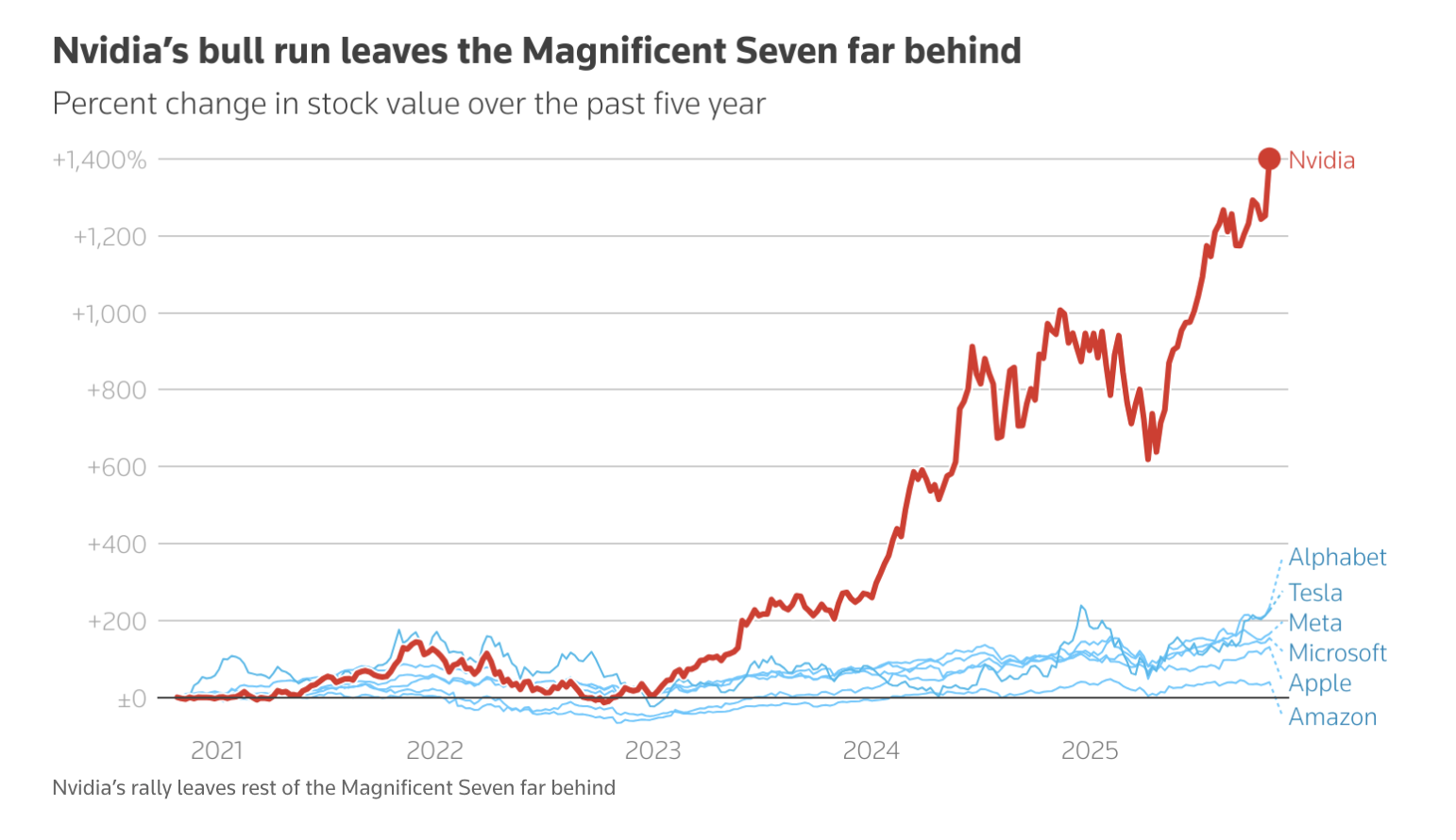
Nvidia hits $5 trillion valuation as AI boom powers meteoric rise. Photo: Reuters.
showing even AI leaders know the numbers don't add up. As one analyst perfectly captured it: "It's that old adage of in a gold rush you want to be selling the picks and shovels—Nvidia is the picks and shovels," but what happens when even the shovel seller needs impossible returns to justify its valuation?
$5 trillion AI spending equals 17 Apollo moon programs in scale
The infrastructure spending has reached astronomical levels with predictions of $5 trillion going into AI and data centers over the next few years—equivalent to 17 Apollo programs at $300 billion each in today's money, with hundreds of data centers popping up across Australia alone. Consider the unprecedented scale of this buildout:
Tech hyperscalers must generate massive returns just to break even on infrastructure. Data centers consuming more power than small cities are being built globally
Investment dwarfs any previous technological revolution including the internet. Companies spending far more on AI infrastructure than they can possibly recoup.
The OECD is warning about risks to the broader US economy from overvalued tech stocks, with analysts noting "the fact that we're talking about a bubble but still investing in that bubble is very curious—sooner or later somebody is going to stop passing the parcel, the music will stop and it could get quite ugly." James Thompson from the Australian Financial Review sees parallels to the dotcom bubble, warning of a "reverse wealth effect" when portfolios crash and spending slows.
Australian super funds trapped with $600 billion exposure to US tech bubble
Australian superannuation funds have $600 billion invested in the US with significant exposure to tech stocks, expected to reach $2 trillion by 2035—meaning "Australian savers are more exposed to share markets than we've ever been in history" according to James Thompson. IFM Investors' chief economist Alex Joiner admits funds have outgrown the Australian market and "need to be where the tech stock action is," even as everyone acknowledges the bubble risk, because it's been "really beneficial for superannuation members returns" so far. The contradiction is stark: analysts simultaneously warn "we are absolutely in an AI bubble now, it is going to burst, I don't know when" while continuing to pour retirement savings into overvalued tech stocks because there's nowhere else to generate returns. Will the promised "profoundly game-changing" benefits for future generations materialize before the bubble bursts, or are we watching history's most expensive game of musical chairs?


